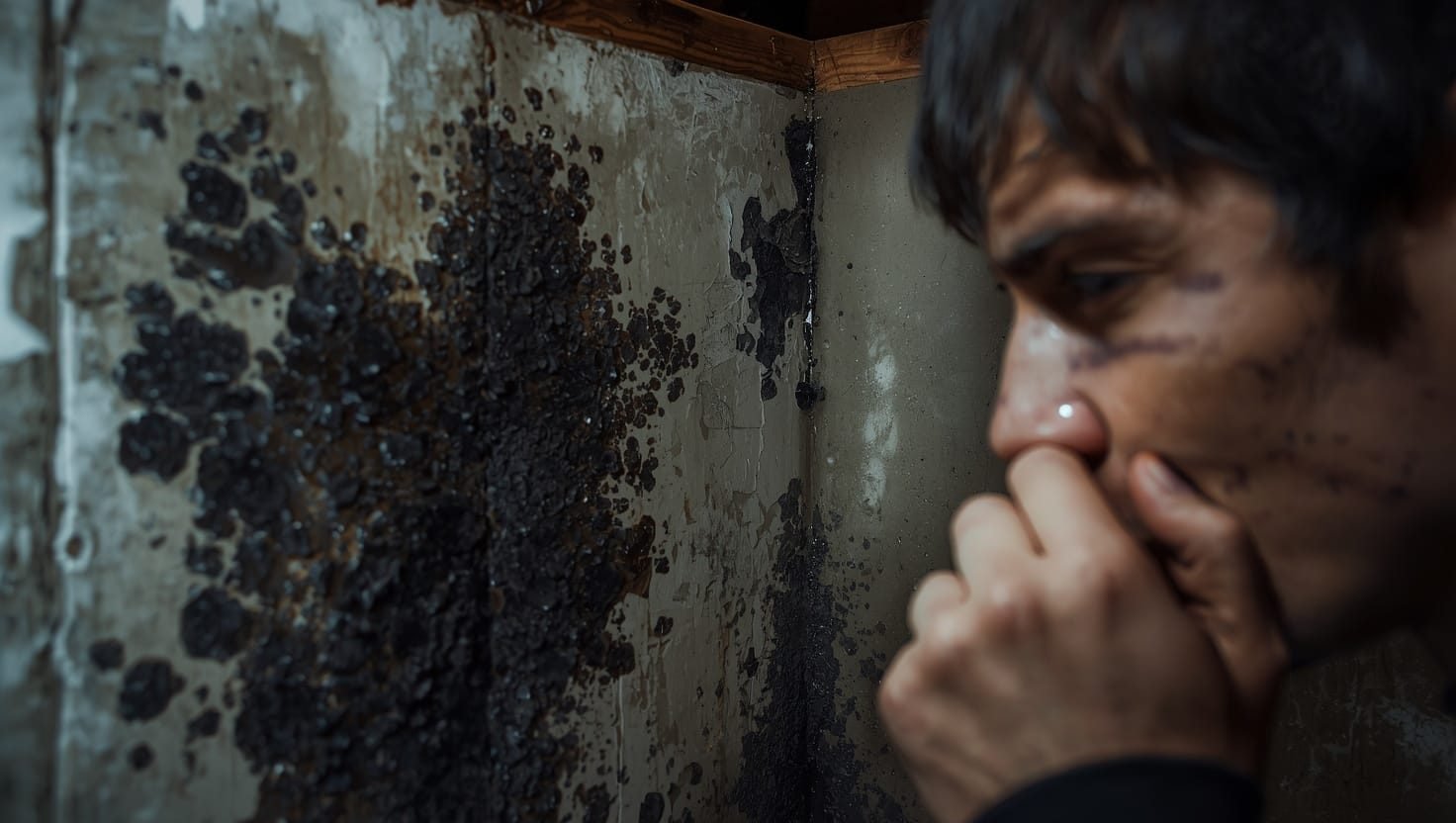
What Does Black Mold Smell Like? (Hint: Run)
- Wolfe McNeel
You Smell Something Off in Your Walls—But Can’t Find It. What Does Black Mold Smell Like?
That musty, earthy odor creeping through your basement or attic?
It might not be just old dust.
Black mold has a distinct smell—and catching it early can save you thousands in damage and health issues down the road.
The truth is, your nose might be your best early warning system before visible growth takes over.
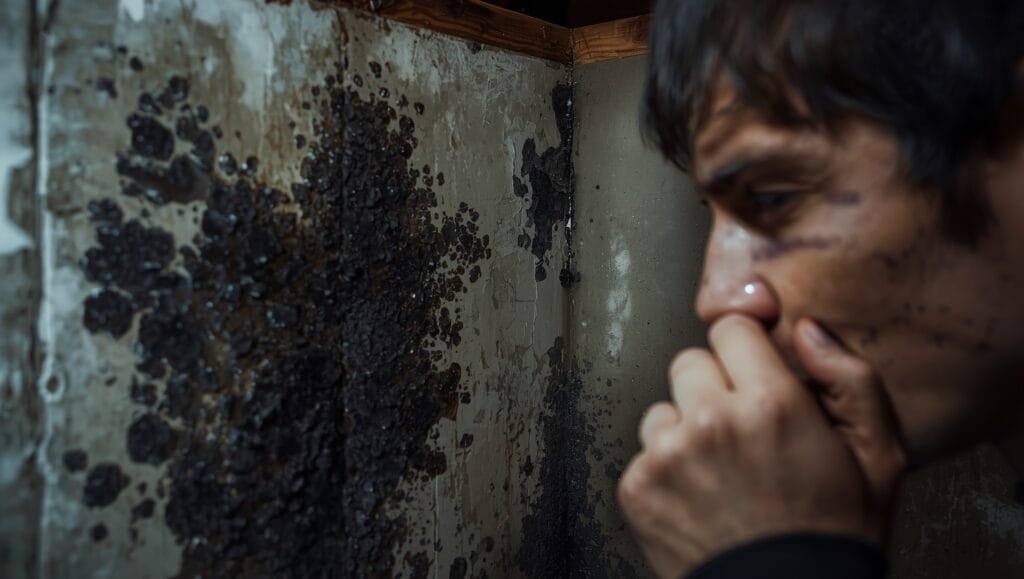
Black mold produces a musty, earthy smell that many people describe as similar to wet soil or decaying leaves.
It’s not always pungent—sometimes it’s subtle enough that you’ll catch a whiff only when you’re standing directly near the problem area.
Other times, the smell is strong enough to fill an entire room or crawlspace.
The intensity depends on how much mold is growing, how long it’s been there, and how well-ventilated the space is.
If you’re picking up on this smell in your Rochester, NY home, don’t ignore it.
Mold remediation becomes exponentially more expensive the longer it sits—and black mold is one of the most aggressive types you can encounter.
Why Black Mold Smells the Way It Does
Mold doesn’t just grow on surfaces—it releases spores and volatile organic compounds (VOCs) into the air.
Those compounds are what create that distinctive smell.
Think of it like this: when you cut grass, you smell that fresh, green scent because the plant releases compounds when damaged.
Black mold works similarly, except instead of a pleasant smell, you get something that makes your stomach turn.
The musty odor comes from microbial volatile organic compounds (mVOCs) that mold produces as it breaks down organic material—wood, drywall, insulation, carpet, whatever it’s feeding on.
Different types of mold produce different smells, but black mold (Stachybotrys chartarum) tends toward that earthy, wet basement vibe.
Here’s what matters: you don’t need a laboratory test to know something’s wrong.
Your senses are telling you there’s moisture and decay happening somewhere—and moisture + darkness = mold’s playground.
Bottom line: Black mold releases compounds that create a musty, earthy smell—your body’s natural alarm that something’s growing where it shouldn’t be.
What That Smell Actually Tells You (And Doesn’t Tell You)
A musty smell doesn’t automatically mean you have black mold.
Could be regular mold, could be mildew, could be moisture without any visible growth yet.
But here’s the deal: if you’re smelling it, there’s moisture and organic decay happening.
That’s the real problem.
Mold follows moisture like a shadow—it’s not the first threat, it’s the second one.
One homeowner in Rochester called us after noticing a persistent musty smell in their basement for weeks.
They figured it was just old concrete and dampness.
When we arrived, we found extensive mold growth behind the drywall, hidden from view but spreading fast.
The repair ended up costing $8,500 instead of the $2,000 it would’ve been if caught earlier.
That smell was the warning label they almost missed.
The smell alone won’t tell you:
- How much mold is actually present
- Whether it’s black mold or another type
- How deep the contamination goes
- What’s already been damaged behind walls or under flooring
What it does tell you is that you need to act.
Not panic—act.
There’s a difference.
Bottom line: Musty smell = moisture problem exists; get it inspected before mold takes over your structure and your wallet.
Where Black Mold Hides and Why You’re Smelling It Now
Black mold loves three things: darkness, moisture, and organic material to feed on.
Your walls, attic, basement, and crawlspace are basically five-star resorts for this stuff.
Common spots where black mold grows (and where you’ll catch that smell):
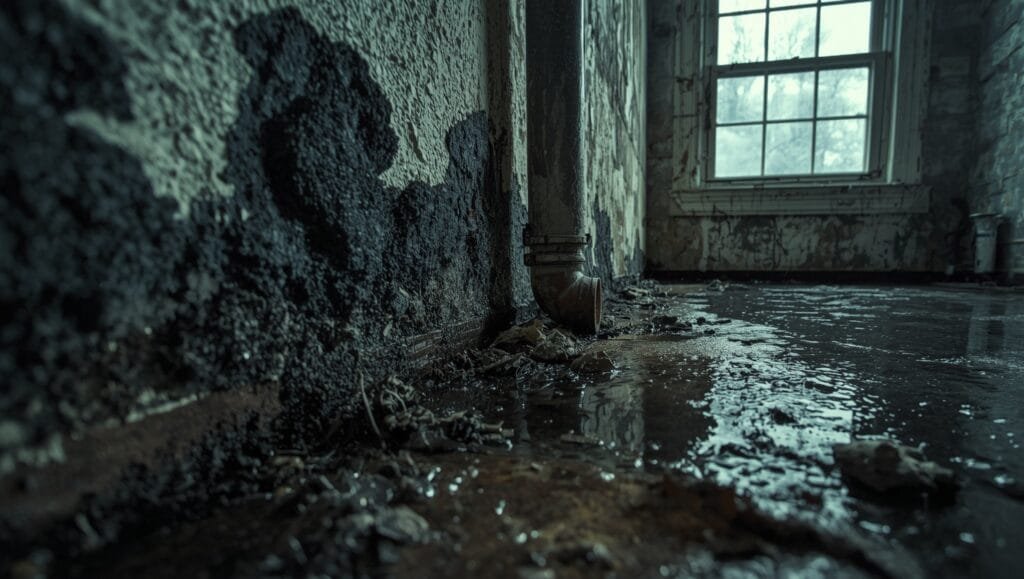
- Basements and crawlspaces — These are naturally damp, especially after heavy rain or if your foundation has cracks.
- Around windows and doors — Condensation and water seepage create the perfect breeding ground.
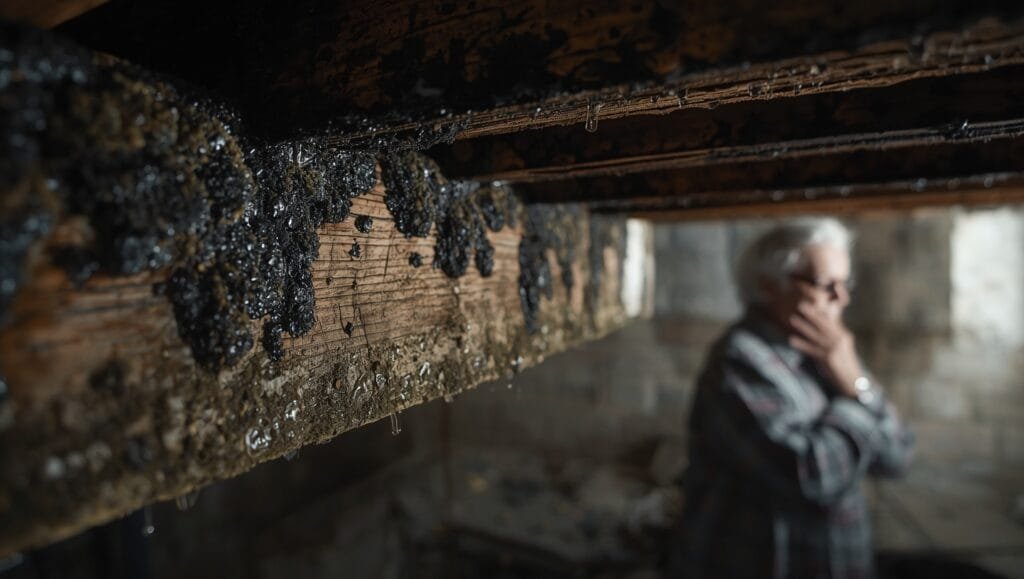
- Attics — Roof leaks, poor ventilation, and temperature fluctuations create ideal conditions.
- Behind walls — Pipe leaks, water intrusion, or previous water damage you didn’t fully dry out.
- HVAC systems and ductwork — If your air ducts have moisture buildup, mold grows and spreads spores throughout your entire house.
- Under sinks and around plumbing — Small leaks you don’t notice until the smell hits you.
The reason you’re smelling it now is probably one of these scenarios:
The mold colony has grown large enough to release noticeable amounts of spores and VOCs into the air.
Or seasonal changes—spring thaw, summer humidity, or fall moisture—have activated dormant growth.
Or you’ve had a recent water event (burst pipe, roof leak, flooded basement) that’s feeding the mold’s growth cycle.
Water damage is the root cause of mold, and it happens faster than most people think.
Mold can colonize in as little as 48 hours if conditions are right.
Bottom line: Basements, attics, and hidden wall spaces are mold’s favorite hideouts—and that smell means it’s already established.
How to Confirm You’re Dealing with Black Mold (Not Just a Musty Smell)
Here’s the honest truth: you can’t identify black mold by smell alone.
You need to see it.
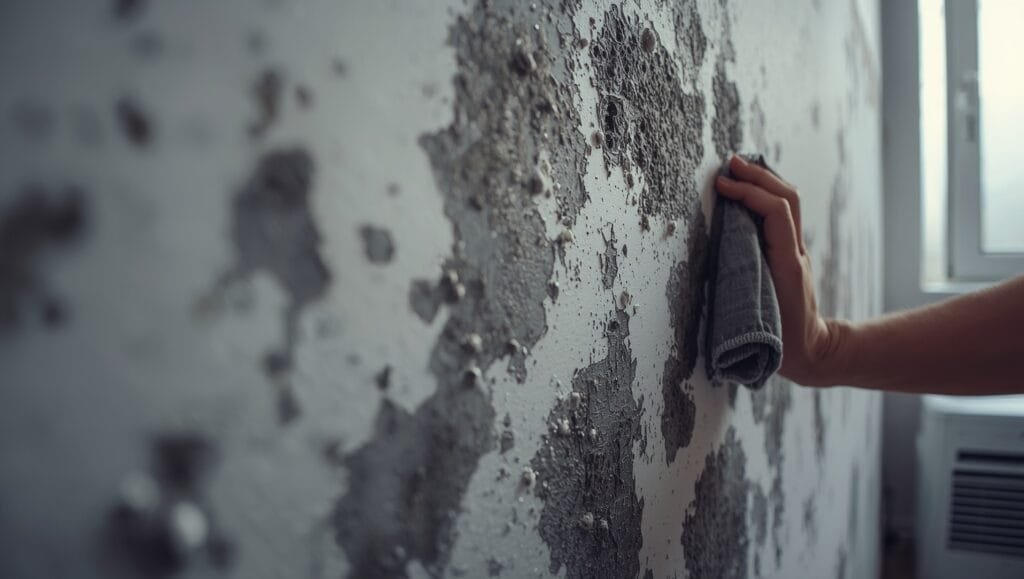
Black mold typically appears as dark green or black spots or patches, often with a slimy texture.
It grows in clusters and can spread across large surface areas quickly.
Unlike some molds that are white or orange, black mold is unmistakable once you spot it.
But here’s the catch—it often grows where you can’t see it.
Behind drywall, under flooring, inside ductwork, in wall cavities.
That’s why the smell is so valuable: it’s telling you to look deeper.
If you’re smelling mold but can’t find visible growth, check these spots:
- Crawl spaces and basement corners (use a flashlight)
- Around the perimeter of your basement where walls meet the floor
- Inside your HVAC return air vents and ductwork
- Under bathroom and kitchen sinks
- Around window frames and sills
- Inside your attic near the roof line
If you find black or dark green growth with that earthy smell, you’ve got a problem.
If you’re smelling it but can’t locate the source, that’s actually a sign the contamination is more widespread than you think.
That’s when you call in professionals like JetDry’s mold remediation team in Rochester, NY.
They have the tools and experience to find hidden mold before it becomes a $10,000+ repair.
Bottom line: Smell + search for visible growth; if you find dark patches, it’s time to call professionals immediately.
The Real Cost of Waiting (And Why That Smell Matters)
People often ask: “Is it really that bad if I just ignore the smell for a few weeks?”
Yeah, it is.
Mold doesn’t grow in a straight line—it grows exponentially.
Week one, it’s a small patch.
Week three, it’s spread across multiple surfaces.
Week six, it’s in your walls, your insulation, and your structural materials.
The cost escalates just as fast.
A small mold remediation job (under 10 square feet) typically runs $500–$2,000.
A moderate contamination (10–100 square feet) jumps to $2,000–$6,000.
A large-scale job with structural damage and hidden growth?
You’re looking at $10,000–$30,000 or more.
That’s not even counting the potential health impacts—respiratory issues, allergic reactions, and aggravated asthma, especially in kids and elderly family members.
One Rochester homeowner ignored a musty smell in their attic for eight months.
When they finally called for an inspection, the mold had compromised the roof structure, insulation, and attic framing.
The remediation and repairs cost $16,000.
If they’d called when they first noticed the smell, it would’ve been $2,500.
That’s a $13,500 difference for waiting.
Bottom line: Act on that smell now—waiting costs exponentially more in repairs and potential health risks.
What to Do Right Now If You’re Smelling Black Mold
Step one: Stop and assess.
You’ve got a musty smell.
That’s your signal.
Don’t panic, but don’t ignore it either.
Step two: Look for the source.
Walk around your property and narrow down where the smell is strongest.
Is it coming from the basement?
The attic?
A specific room?
That tells you where to focus.
Step three: Check for visible mold.
Once you’ve located the smell, look for dark patches, discoloration, or slimy growth on surfaces.
Check walls, ceilings, around pipes, near windows, and in crawlspaces.
Step four: Assess moisture sources.
Look for obvious water problems—leaks, standing water, condensation, or damp spots.
If you can find the moisture source, you’re halfway to solving the problem.
Step five: Call a professional if you can’t find the source or if the mold is extensive.
This is where most people should be at this point.
Mold that’s hidden behind walls or spread across large areas requires professional remediation.
Walt Latuik and the team at JetDry offer 24/7 emergency mold remediation in Rochester, NY.
They’ve been handling exactly this situation for over 20 years.
They’ll inspect your property, identify all affected areas (visible and hidden), and remove the mold safely while addressing the moisture source so it doesn’t come back.
Don’t DIY this if you’re dealing with black mold.
Disturbing mold colonies releases spores into the air, which can spread contamination and expose you to health risks.
Professionals have containment equipment and proper disposal procedures.
Bottom line: Locate the smell, look for growth, check for moisture—then call professionals if you can’t handle it safely yourself.
The Moisture Problem Behind the Smell
Here’s what people miss: the smell isn’t your real problem.
It’s a symptom.
The real problem is moisture.
Black mold won’t grow without it.
Fix the moisture, and you stop the mold from spreading—even if some residual spores linger.
Common moisture sources in Rochester homes:
- Foundation cracks allowing groundwater seepage
- Poor drainage around the perimeter of your property
- Leaking or clogged gutters
- Roof leaks from missing shingles or poor flashing
- Plumbing leaks (visible or hidden)
- HVAC condensation not draining properly
- High indoor humidity (above 60%)
- Inadequate ventilation in bathrooms and kitchens
Once mold is removed, if you don’t fix the moisture source, mold will come back.
It’s not a question of if—it’s when.
That’s why professional remediation includes both removal and moisture control.
You’re not just killing mold; you’re preventing its return.
Controlling humidity and moisture in your home is the long-term defense against black mold.
Bottom line: Moisture feeds mold—fix the source or the smell (and the mold) will be back within months.
Black Mold Smell vs. Other Odors: Can You Tell the Difference?
Not all musty smells are black mold.
Sometimes it’s regular household mold (which is still a problem, just less aggressive).
Sometimes it’s mildew.
Sometimes it’s just stale, damp air with no visible growth yet.
But here’s what matters: they all point to the same issue—moisture and decay.
Black mold specifically smells earthy and musty, like wet soil or a basement after heavy rain.
It’s organic and slightly sweet, almost like decomposing plant matter.
If you’re smelling something that’s:
- Sharp or chemical-like — could be mildew or cleaning product residue
- Sweet or fruity — might be mold, but could also be bacterial growth
- Rotten or foul — could be severe water damage, dead animals, or advanced decomposition
- Earthy and damp — classic black mold smell
The exact smell matters less than the fact that you’re smelling something abnormal.
Your home shouldn’t smell musty.
If it does, there’s a problem worth investigating.
Bottom line: Musty smells all point to moisture problems—the exact odor type matters less than addressing the underlying cause.
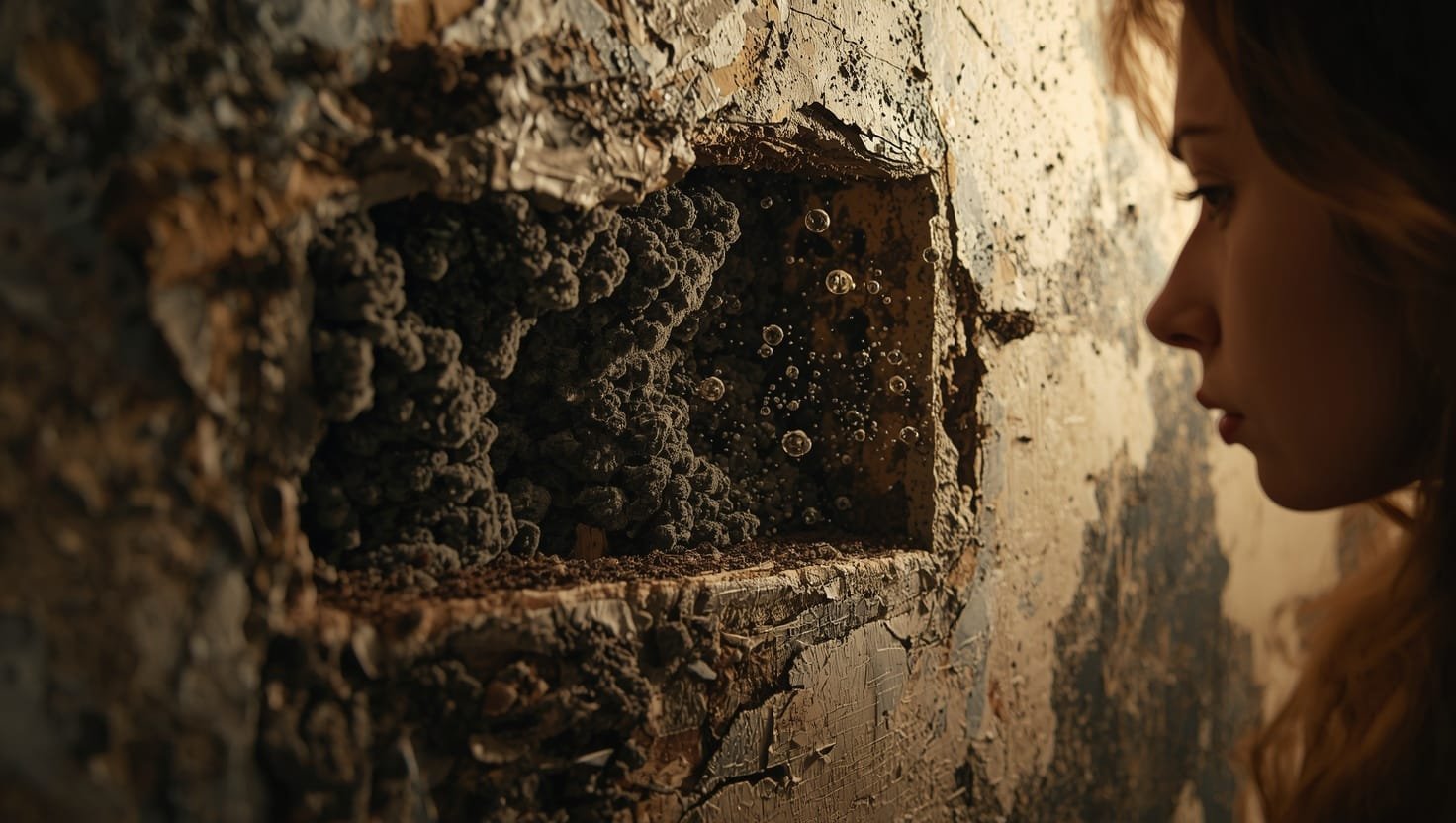
Black Mold Smell Getting Worse? Here’s What’s Actually Happening Inside Your Walls
You noticed that musty odor last week.
Now it’s stronger.
Maybe it’s moved to a different room.
Maybe your throat feels scratchy when you’re in the basement.
That escalation isn’t random—and it’s not something to wait out.
Black mold smell intensifies because the colony is growing, releasing more spores and volatile organic compounds into your air.
The smell getting worse is your home literally telling you the problem is spreading faster than you think.
Here’s what you need to know: mold doesn’t just sit in one spot and chill.
It’s aggressive.
It’s hungry.
And once it starts producing noticeable odor, you’re already past the early warning phase.
Bottom line: Worsening mold smell means active growth—act now before it costs you thousands.
Why the Smell Gets Stronger Over Days or Weeks
Mold colonies operate like any living organism—they grow, reproduce, and expand their territory.
When a colony is small (under a few square inches), it releases minimal spores and mVOCs into the air.
You might not smell anything yet.
But as the colony doubles in size—which can happen in days under the right moisture conditions—the volume of compounds it releases multiplies.
That’s when you start noticing the smell.
Then it gets stronger.
A Rochester homeowner called JetDry after noticing a faint musty odor in their crawlspace.
They thought about calling someone “eventually.”
Two weeks later, the smell had reached the main floor, and their kids were complaining about headaches.
When Walt’s team arrived, they found mold covering over 300 square feet of subfloor and insulation.
The damage had tripled in those two weeks alone.
What changed?
The moisture level stayed consistent, but the mold colony had room to grow—so it did, aggressively.
The smell progression usually follows this pattern:
- Week 1: Faint, barely noticeable odor in one localized area
- Week 2: Smell is present most days; you catch it when entering the space
- Week 3: Odor is persistent and noticeable; sometimes lingering on your clothes
- Week 4+: Smell fills entire rooms or spreads to adjacent areas; may affect multiple levels of the house
Each week represents exponential mold growth—not linear growth.
That’s the scary part.
Bottom line: Escalating smell = exponential mold growth; waiting another week means the problem doubles.
The Health Impact of Increasing Mold Exposure
Here’s what most people don’t connect: the stronger the smell, the more spores you’re breathing in.
That matters.
As mold releases more compounds, you’re inhaling higher concentrations of mVOCs and fungal spores.
Your body notices.
Symptoms often show up gradually, so people don’t tie them to mold:
- Persistent cough that doesn’t respond to cough drops or medicine
- Sinus issues that feel like allergies but don’t go away
- Headaches that come and go, especially in certain rooms
- Fatigue that feels disproportionate to your activity level
- Itchy or watery eyes
- Throat irritation or hoarseness
- Wheezing or chest tightness (especially in people with asthma)
Kids and elderly family members are hit harder because their immune systems are weaker.
One Rochester family noticed their 7-year-old developed a persistent cough in late fall.
They treated it like seasonal allergies for weeks.
When they finally got their basement inspected—after the smell became unbearable—they found black mold in the HVAC return air ductwork.
The mold spores were being circulated throughout their entire house.
The kid’s cough cleared up within two weeks of mold removal.
The scary part?
That family was breathing in spores every single day for months.
No one knew where the health issues were coming from until they connected the dots to the smell.
Black mold produces mycotoxins—toxic compounds that some strains release as a defense mechanism.
Stachybotrys chartarum (the “black mold” everyone talks about) does produce mycotoxins, though the level of toxicity in homes is debated by scientists.
What’s not debated: more mold = more potential for respiratory and immune issues.
Don’t ignore this.
If your family’s health is declining alongside the smell intensifying, there’s a connection.
Bottom line: Worsening smell + health symptoms = get professional inspection immediately.
Where the Smell Is Coming From (And Why It’s Spreading)
The fact that the smell is getting stronger or spreading to new areas tells you something important: the moisture source is still active, and mold is finding new surfaces to colonize.
Smell doesn’t spread randomly.
It follows air currents.
If the odor started in the basement and now you’re catching it on the first floor, that’s either because:
1. The mold colony itself is spreading to new areas.
The original moisture source is feeding growth, and mold is creeping along wood, insulation, and drywall toward new territory.
Mold spreads by releasing spores that land on nearby surfaces and colonize if conditions are right.
2. Your HVAC system is circulating mold spores throughout the house.
If mold is growing in your ductwork, return air vents, or near your air handler, every time your furnace or AC runs, it’s pushing spores into every room.
This is why the smell can suddenly feel pervasive.
3. Multiple mold colonies exist in different areas.
You might have mold in the basement, the attic, and behind a bathroom wall—all growing independently.
As each colony expands, the smell compounds.
One thing people miss: the smell doesn’t mean the mold is only in the area where you smell it strongest.
The strongest smell is just where the largest or most active colony is.
But there could be smaller colonies elsewhere that aren’t producing enough odor to notice yet.
That’s why a professional inspection is non-negotiable at this point.
JetDry uses thermal imaging and moisture meters to find hidden mold growth behind walls, under flooring, and inside ductwork—places you can’t see but where the real damage is happening.
Bottom line: Spreading smell means mold is colonizing new areas or circulating through your HVAC system.
The Window of Opportunity Is Closing (And Here’s Why Speed Matters)
This is the hard truth nobody wants to hear: the longer you wait, the more you pay.
Not just in dollars—in structural damage, health risks, and emotional stress.
When mold smell is intensifying, you’re in what contractors call the “critical intervention window.”
This is the phase where professional remediation is still manageable and relatively contained.
Wait another month, and you enter the “advanced damage phase.”
Structural materials start compromising.
Insulation becomes saturated.
Wood framing begins to rot.
Here’s a real example from a Rochester homeowner who waited too long:
She noticed a musty smell in her attic in March.
“I’ll get to it in the spring,” she thought.
By May, the smell was unbearable.
She finally called for an inspection.
The mold had compromised 60% of the attic framing.
The insulation was saturated and needed complete replacement.
The roof decking had softened in spots.
What would’ve been a $3,500 remediation job in March became a $14,200 project in May—plus $8,000 in structural repairs.
That’s not a coincidence.
Mold grows exponentially.
Damage compounds at the same rate.
The cost breakdown typically looks like this:
- Caught early (faint smell, no visible growth): $500–$2,000
- Moderate (obvious smell, some visible growth): $2,000–$6,000
- Advanced (strong smell, extensive growth, structural damage): $10,000–$30,000+
- Severe (smell throughout house, multiple areas, structural failure risk): $30,000–$75,000+
You’re probably in that second or third category right now.
The smell is noticeable.
Maybe you’ve seen some growth or water staining.
This is the moment where a quick call to professionals saves you tens of thousands.
Bottom line: Worsening smell means you’re in the critical window—waiting another week could double the cost.
Testing the Air: Should You Get Your Home Tested?
A lot of people ask: “Should I get mold testing done before calling a remediation company?”
Short answer: not yet.
Here’s why: air testing for mold is expensive ($300–$800 per test), and the results don’t change what you need to do.
You’ve got a strong smell.
That’s your test result right there.
Air mold tests measure spore counts in your home’s air.
Even if the count is “acceptable,” you still have visible mold or hidden growth causing the smell.
Knowing the exact spore count doesn’t accelerate remediation—it just delays action while you wait for lab results.
What you actually need is a professional inspection with moisture mapping and thermal imaging.
That’s what identifies where the mold is, how extensive it is, and what’s causing the moisture problem.
If you want testing later—after mold has been removed—that’s useful for verifying the remediation worked.
But right now, testing delays the action you need to take.
Walt’s team at JetDry starts with a visual inspection and moisture assessment.
They’ll identify the problem, outline the scope of work, and explain exactly what they’re removing and why.
No guessing.
No unnecessary tests.
Bottom line: Skip air testing now; get professional inspection to find and remove the source instead.
What Professional Mold Removal Actually Stops (And What It Doesn’t)
Here’s something critical to understand: mold removal isn’t magic.
It’s science—but science that requires precision.
When a professional removes black mold, they’re doing three things:
1. Containment.
They seal off the affected area so spores don’t spread to uncontaminated parts of your house during removal.
This is why DIY removal is dangerous—you’re likely spreading spores everywhere.
2. Removal.
They physically remove contaminated materials (drywall, insulation, flooring) and clean all surfaces with antifungal solutions.
Any material that can’t be safely cleaned is disposed of.
3. Moisture control.
They identify and fix the root cause—the water source feeding the mold.
This is the part most people skip, and it’s why mold comes back.
What professional removal stops:
- Active mold growth in the treated area
- Spore release and odor from that location
- Further structural damage from that specific moisture source
- Health risks from direct exposure to that mold colony
What it doesn’t do:
- Eliminate all mold spores from your home (spores are everywhere in nature; the goal is to reduce them to normal levels)
- Fix unrelated moisture problems elsewhere in your house
- Prevent future mold if you don’t address the moisture source
- Reverse structural damage that’s already occurred
The key: if you don’t fix the moisture problem, mold will come back—often within 6–12 months, sometimes faster.
That’s not the remediation company’s fault; that’s just mold’s nature.
A Rochester homeowner had their basement mold removed for $4,000.
Nine months later, the smell was back.
Turns out, they’d fixed the mold but not the foundation crack letting water seep in during heavy rain.
The second remediation cost $3,500 because the damage was less extensive, but it was still preventable.
Professional companies like JetDry address both issues—removal and prevention—in one project.
Bottom line: Mold removal stops active growth; moisture control stops it from coming back.
FAQ: Black Mold Smell Questions Answered
Can you get sick from just smelling black mold?
Smelling mold itself won’t make you sick, but the spores and compounds you’re breathing in can cause respiratory and allergic reactions over time.
The smell is a sign you’re inhaling mold particles.
How fast does black mold spread once you smell it?
Once you can smell mold, the colony is usually several weeks old and actively growing.
From that point, it can double in size within 7–14 days under ideal moisture conditions.
Speed depends on humidity, temperature, and available organic material.
Does opening windows help with black mold smell?
Opening windows dilutes the smell temporarily by introducing fresh air, but it doesn’t remove the mold.
It’s a band-aid that makes you feel better while the problem grows behind your walls.
You need actual remediation.
Will black mold smell go away on its own?
No.
The smell will persist or intensify as the mold colony grows.
It won’t disappear without professional removal and moisture control.
Can I use bleach to kill the black mold smell?
Bleach kills surface mold but doesn’t penetrate porous materials like drywall or insulation where mold roots deep.
It’s also ineffective on hidden mold behind walls.
Professional remediation with proper containment is the only way to address the problem comprehensively.
Is black mold smell worse in certain seasons?
Yes.
Humidity and temperature fluctuations in spring and fall accelerate mold growth.
Winter cold can slow growth, but mold in heated homes continues spreading.
Summer heat and humidity create ideal conditions for rapid expansion.
Your Next Move: Stop the Spread Before It Costs You Big
You’re at a decision point.
The smell is noticeable.
It’s probably getting worse.
You’ve got maybe a week or two before the damage escalates into the “expensive repair” territory.
Here’s what to do right now:
Step 1: Stop ignoring it.
I know that sounds harsh, but denial is costing you money every single day.
Step 2: Find the strongest smell area.
Walk through your home and pinpoint where the odor is most intense.
That’s your ground zero.
Step 3: Look for visible signs.
Check walls, ceilings, and surfaces near that area for dark patches, discoloration, or water staining.
Even if you don’t see mold, wet or damp spots tell you where moisture is active.
Step 4: Call a professional immediately.
Not next month.
Not next week.
This week.
Walt Latuik and the team at JetDry’s mold remediation services in Rochester, NY respond to calls like yours every single day.
They’ve been handling exactly this situation for over 20 years.
They’ll come out, assess the scope, identify the moisture source, and give you a clear plan with pricing.
What makes them different?
Walt shows up.
He’s hands-on, even on holidays and weekends.
He doesn’t oversell the job or recommend unnecessary work.
He fixes the problem and prevents it from coming back.
Contact JetDry now for a same-day or next-day inspection.
They’re available 24/7 for emergencies.
The call is free.
The inspection is straightforward.
The results speak for themselves.
Don’t wait another week.
That smell isn’t going anywhere—and neither is your wallet if you ignore it.
Bottom line: Call JetDry now—waiting costs thousands more and puts your family’s health at risk.

Your Nose Isn’t Lying—But Neither Is Your Wallet If You Ignore It
That smell creeping through your home?
It’s doing more than making your nose wrinkle.
It’s costing you money every single day you don’t act.
And if you think you can just open a window and call it solved, you’re about to learn an expensive lesson.
The black mold smell you’re catching isn’t some minor inconvenience—it’s your home’s distress signal.
And the longer you ignore it, the more damage compounds behind your walls, under your floors, and inside your air ducts.
What most people don’t realize is that the smell itself is just the tip of the iceberg.
The real destruction is happening where you can’t see it.
Bottom line: That smell costs you thousands more every week you delay—act now, not later.
The Timeline: How Fast Does Hidden Damage Actually Spread?
Let’s talk numbers because this is where the reality hits different.
You catch a faint musty odor on a Monday.
By Friday, it’s noticeable in two rooms.
By the following Wednesday, it’s everywhere.
That’s not coincidence—that’s exponential growth doing its thing.
Mold doesn’t grow in a straight line.
It multiplies.
A colony the size of a postage stamp can become a square foot in less than a week under the right conditions (moisture, warmth, organic material to feed on).
One Rochester homeowner noticed a smell in their basement in early September.
They figured they’d deal with it after Labor Day.
By mid-September, the smell had reached the first floor.
By October, their kids were complaining about headaches and coughing.
When Walt’s team finally inspected the property in late October, they found mold across 450 square feet of basement walls, floor joists, and insulation.
The remediation cost jumped from an estimated $3,000 (if caught in September) to $11,500 (by October).
That’s an $8,500 difference for waiting six weeks.
The damage progression follows a predictable pattern:
- Week 1–2: Mold colonizes in one hidden area; smell is faint and localized
- Week 3–4: Colony doubles in size; smell becomes obvious; moisture spreads to adjacent materials
- Week 5–8: Mold reaches multiple areas; structural materials start absorbing moisture; wood begins softening
- Week 9+: Damage becomes structural; insulation is saturated; drywall integrity compromised; repair costs skyrocket
The kicker?
Mold doesn’t care about your schedule.
It’s growing 24/7, seven days a week, as long as moisture is present.
Bottom line: Every week you wait, remediation costs double—delay six weeks, lose $8,000+ in preventable expenses.
Why Professional Inspection Beats DIY Guessing Every Time
You might be tempted to grab a flashlight and do some detective work yourself.
That’s understandable.
But here’s what actually happens when you try to locate hidden mold without the right tools.
You find a small patch on visible drywall and think you’ve solved the mystery.
Meanwhile, mold is thriving inside your walls, under your flooring, and deep in your insulation—places your eyes can’t reach.
Professional inspectors use thermal imaging cameras that detect temperature variations indicating moisture buildup.
They use moisture meters that measure humidity levels inside walls before any visible damage appears.
They use borescopes to peer into wall cavities and ductwork.
They know exactly where mold hides because they’ve been doing this for decades.
Walt’s team at JetDry doesn’t just show up and guess.
They map out your home’s moisture patterns, identify every affected area (visible and hidden), and trace the problem back to its source.
A Rochester family called JetDry after noticing a musty smell in their master bedroom.
They’d checked the walls, the closet, under the bed—nothing visible.
When the inspection team arrived with thermal imaging, they discovered mold growing inside the exterior wall cavity behind the drywall, fed by a slow roof leak that had been going unnoticed for months.
The leak itself was the real problem; the smell was just the symptom.
Without that inspection, the homeowner would’ve spent money treating the symptom while the source kept feeding the problem.
That’s the difference between guessing and knowing.
Professional inspection reveals:
- Exact location of all mold colonies (visible and hidden)
- Moisture sources feeding the growth
- Extent of structural damage already done
- Risk of spread to uncontaminated areas
- Proper remediation scope and cost
DIY attempts reveal:
- Whatever you can see with your eyes
- Nothing else
When you’re making a decision that could cost $3,000 or $15,000 depending on what’s actually happening, doesn’t it make sense to know what you’re actually dealing with?
Bottom line: Professional inspection finds hidden damage before costs explode; DIY guessing leaves you flying blind.
The Moisture Source Is the Real Enemy—Not Just the Mold
Here’s what separates people who solve their mold problem from people who fight it repeatedly: understanding that mold is the symptom, not the disease.
The disease is moisture.
You can remove every trace of mold in your home, spend thousands on it, and have it come roaring back in six months if you haven’t stopped the water from getting in.
Common moisture sources in Rochester homes that feed mold growth:
- Foundation cracks allowing groundwater seepage (especially after heavy rain or spring thaw)
- Roof leaks from missing shingles, damaged flashing, or poor ventilation
- Plumbing leaks—both visible and hidden inside walls
- HVAC condensation lines that aren’t draining properly or are clogged
- Poor grading around your property causing water to pool near the foundation
- Clogged gutters and downspouts directing water toward your house instead of away
- Bathroom and kitchen exhaust fans venting into attics instead of outside
- High indoor humidity (above 50–60%) from poor ventilation
Mold remediation companies that don’t address these sources are basically putting a band-aid on a bullet wound.
The mold will come back because the environment that created it is still there, still wet, still hungry.
That’s why proper mold remediation in Rochester always includes moisture control.
You’re not just killing mold; you’re making your home uninhabitable for it.
One family in Rochester had their basement mold removed for $4,200.
Within eight months, the smell was back.
Turns out, the remediation removed the mold but nobody fixed the sump pump that had failed, allowing groundwater to seep in continuously.
The second remediation cost $3,800 because the damage was less extensive, but it was completely preventable.
The real cost wasn’t $8,000.
It was $4,200 plus the frustration of dealing with the problem twice, plus the health impacts of living with mold spores for those eight months, plus the risk that structural damage was getting worse during that time.
Bottom line: Fix moisture or mold returns within months—remediation without prevention is throwing money at a leaking pipe.
What Happens to Your Home’s Structure When Mold Feeds for Months
Mold doesn’t just sit on surfaces looking gross.
It’s actively eating through the materials your home is built from.
Wood framing becomes soft and spongy.
Drywall loses structural integrity.
Insulation becomes waterlogged and useless.
Metal components rust.
Concrete and masonry crack and crumble.
The longer mold feeds, the more structural damage compounds.
A Rochester homeowner ignored a musty attic smell for nearly a year.
When they finally got an inspection, the mold had compromised 40% of the roof framing.
The wood had softened to the point where you could push your finger through it.
The roof was actually sagging in one spot—not dramatically, but enough that it was at risk of collapse.
The mold remediation itself was $6,500.
The structural repairs (replacing damaged framing, reinforcing joists, replacing roof decking) were $18,000.
The total damage: $24,500 for waiting.
If caught at the smell stage?
Probably $2,500 total—remediation plus minor repairs.
That’s a $22,000 lesson in not ignoring that musty odor.
Structural damage from prolonged mold exposure includes:
- Wood rot in floor joists, wall studs, and roof framing (irreversible)
- Drywall deterioration and potential collapse
- Insulation saturation reducing R-value and energy efficiency
- Metal corrosion in HVAC systems and ductwork
- Foundation cracks widening as moisture penetration increases
- Potential settling or shifting of the structure
Once structural materials are compromised, you’re not just removing mold—you’re rebuilding parts of your house.
That’s exponentially more expensive.
Bottom line: Structural damage from mold costs 5–10x more to repair than catching it early—prevention beats reconstruction.
FAQ: Your Black Mold Smell Questions Answered
Does black mold smell get worse in certain weather?
Yes—humidity spikes during spring thaw, summer rain, and fall moisture accelerate mold growth and intensify the smell.
Cold winter temperatures slow (but don’t stop) mold in unheated spaces; heated homes continue supporting active growth year-round.
Can I use an air purifier to get rid of the black mold smell?
Air purifiers can reduce airborne spores and odor temporarily, but they don’t remove the mold source or stop it from growing.
It’s like spraying cologne over garbage—it smells better for a minute, but the garbage is still rotting.
Will the smell disappear after mold is removed?
Yes, once mold is professionally removed and moisture is controlled, the musty odor typically disappears within days to a week as residual spores settle and the environment becomes inhospitable to mold growth.
What if the smell is in my HVAC system?
Mold in ductwork is serious because it circulates spores throughout your entire home every time your furnace or AC runs.
This requires professional air duct cleaning and mold remediation, not just surface cleaning.
Can I negotiate with my homeowner’s insurance to cover mold remediation?
Insurance coverage for mold depends on the cause—if it’s from a covered water event (burst pipe, roof leak), it might be covered; if it’s from neglect or poor maintenance, it won’t be.
Check your policy and call your agent immediately if you have a claim.
How much does professional mold inspection cost in Rochester?
Professional inspections typically run $300–$600 and include visual assessment, moisture mapping, and sometimes thermal imaging.
It’s an investment that prevents you from overpaying for unnecessary remediation or underestimating the scope of work needed.
The Cost Comparison: Act Now vs. Wait and See
Let’s break down what you’re actually looking at financially, because this is where the decision becomes crystal clear.
Scenario 1: You call a professional this week.
Inspection: $400.
Remediation (small to moderate scope): $2,500–$5,000.
Moisture control repairs: $1,000–$3,000.
Total investment: $3,900–$8,000.
Timeline: 1–2 weeks.
Peace of mind: Immediate.
Scenario 2: You wait four weeks, then call.
Inspection: $400.
Remediation (moderate to extensive scope): $6,000–$12,000.
Moisture control repairs: $2,000–$5,000.
Structural repairs (if damage occurred): $3,000–$10,000.
Total investment: $11,400–$27,000.
Timeline: 3–4 weeks.
Peace of mind: Delayed, worried.
Scenario 3: You wait eight weeks, then call.
Inspection: $400.
Remediation (extensive scope): $10,000–$20,000.
Moisture control repairs: $3,000–$7,000.
Structural repairs: $8,000–$20,000.
Potential health issues from prolonged exposure: Ongoing.
Total investment: $21,400–$47,000.
Timeline: 4–6 weeks.
Peace of mind: Gone.
The math is brutal.
Waiting four weeks can cost you $7,000–$20,000 more.
Waiting eight weeks can cost you $17,000–$40,000 more.
That’s not hyperbole—that’s just how exponential growth works.
Bottom line: Call this week costs $4K–$8K; wait four weeks costs $11K–$27K—the difference is staggering.
What JetDry Does Differently (And Why It Matters)
Not all mold remediation companies operate the same way.
Some show up, spray some antifungal solution, and leave.
Others remove affected materials but don’t address the moisture source.
Still others overestimate the scope and charge you for work you don’t need.
JetDry operates differently because Walt Latuik built the company on a principle: fix the problem completely, or don’t fix it at all.
That means:
- Thorough inspection identifying all affected areas before any work begins
- Professional containment during removal so spores don’t spread
- Complete removal of contaminated materials, not just surface cleaning
- Root cause identification and moisture control to prevent recurrence
- No upselling or unnecessary work—just what’s needed to solve the problem
- 24/7 availability for emergencies, even on holidays
Walt personally responds to many calls.
He’s not a corporate middleman—he’s the owner who’s been handling water damage, mold, and fire restoration in Rochester for over 20 years.
One Rochester family called JetDry after discovering mold in their crawlspace.
Walt’s team arrived the next morning, did a full inspection with thermal imaging, identified a failed sump pump as the moisture source, removed the mold professionally, and repaired the sump pump.
Total time: three days.
Total cost: $5,200.
The family’s relief: priceless.
They knew exactly what was happening, why it happened, and how it was being fixed—not guessing or worrying about hidden damage.
Bottom line: Professional remediation solves the problem completely; half-measures just delay the inevitable.
Your Decision Point: What Are You Going to Do?
You’re reading this because you’ve noticed a smell.
You know something’s wrong.
Your gut’s telling you to act, but you’re probably also thinking, “Maybe it’ll go away,” or “Maybe I can handle this myself,” or “I’ll deal with it next month.”
Stop.
That thinking is costing you money.
The smell won’t go away—it’ll get worse.
You probably can’t handle it safely yourself—mold remediation requires containment and proper disposal.
Next month might be too late—the damage could double.
Here’s what you need to do right now:
Step 1: Pinpoint the smell.
Walk through your home and identify where it’s strongest.
Basement?
Attic?
Specific room?
That’s your starting point.
Step 2: Look for visible signs.
Check walls, ceilings, and surfaces near the strongest smell for dark patches, discoloration, or water staining.
Take a photo if you see anything suspicious.
Step 3: Call a professional today.
Not tomorrow, not next week—today.
JetDry offers 24/7 emergency mold inspection and remediation in Rochester, NY.
The inspection is straightforward, the assessment is honest, and the solution is comprehensive.
Step 4: Get the scope and pricing.
Once you know what you’re dealing with, you can make an informed decision about next steps.
No surprises, no upselling, just facts.
Walt Latuik and his team have saved thousands of Rochester homes from mold damage.
They’ve seen what happens when homeowners wait, and they’ve seen what’s possible when they act fast.
The difference is always measured in thousands of dollars—and sometimes in the health of their families.
You’ve got a choice.
Act this week, or pay for it for months.
The smell you’re noticing right now is your warning.
Don’t ignore it.
Contact JetDry now for emergency mold remediation.
Same-day or next-day inspection available.
24/7 response.
Real solutions, not band-aids.
Bottom line: Call JetDry now—waiting costs thousands more and puts your family’s health at serious risk.