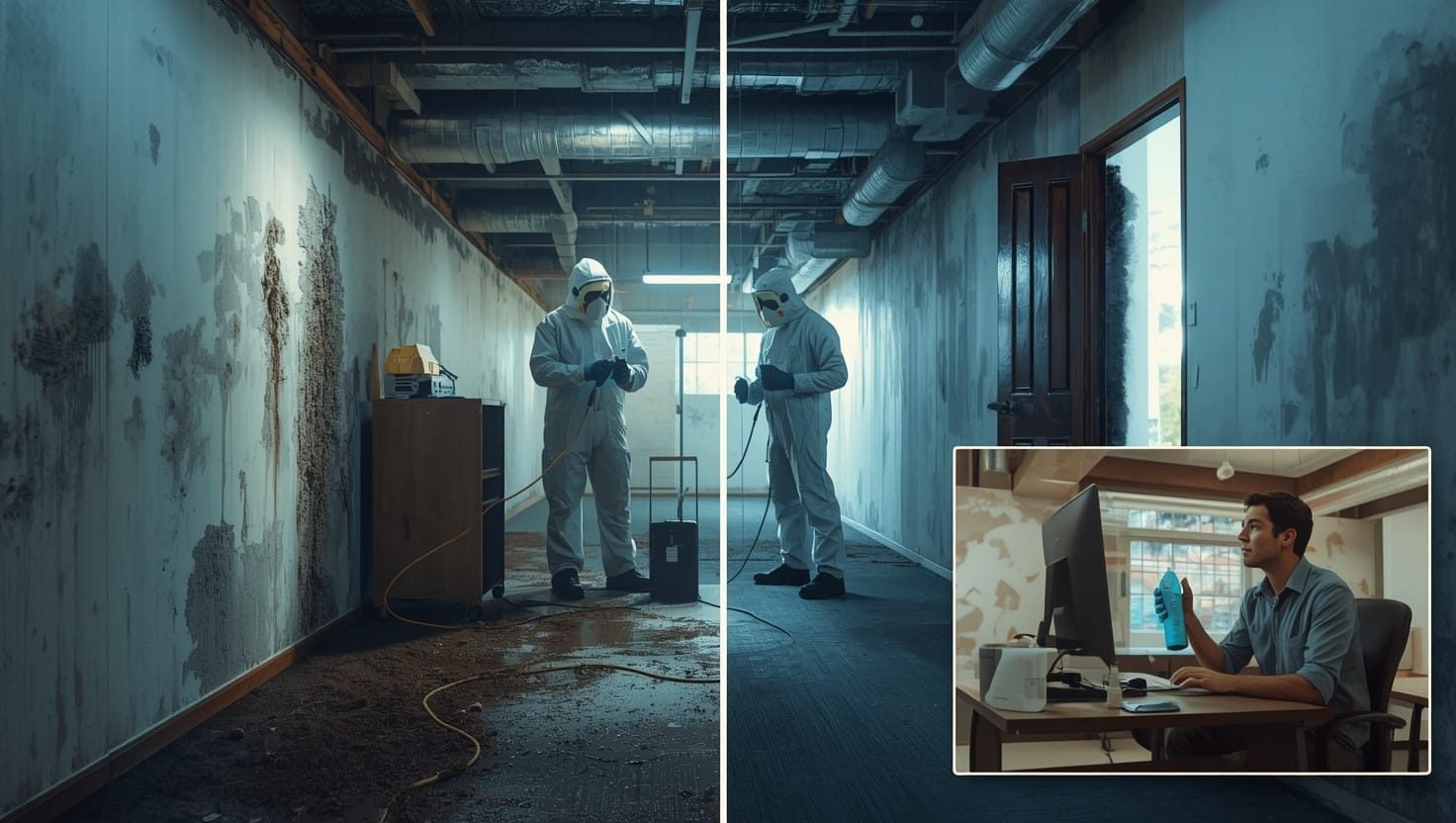
Commercial Mold Damage Restoration: Stop Losing Money
- Wolfe McNeel
Your Business Just Got Hit With Mold. Now What? Why Commercial Mold Damage Restoration Can’t Wait
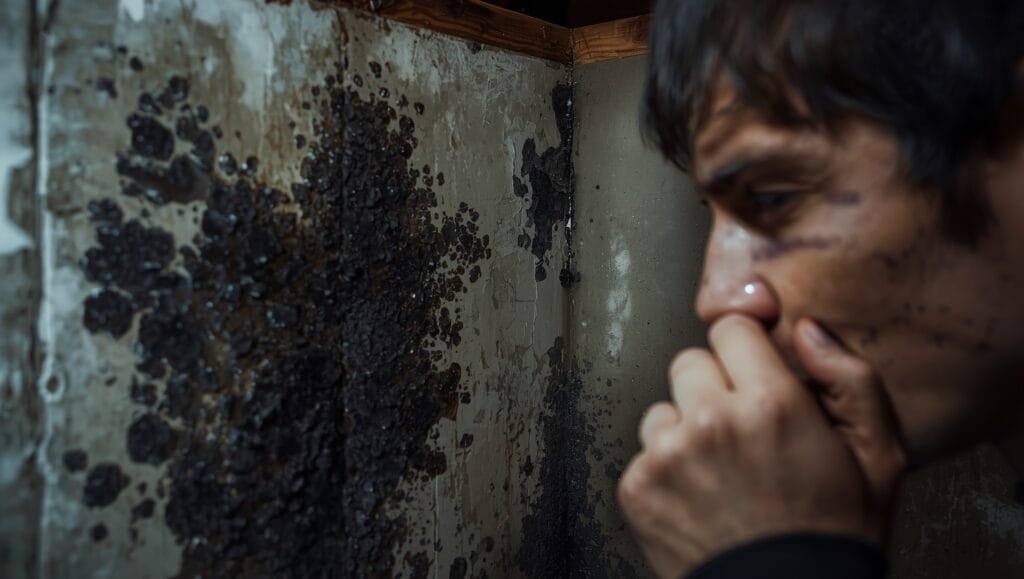
A restaurant owner in Rochester discovered black mold spreading across their walk-in cooler on a Tuesday morning.
By Friday, the health department had already been notified.
By the following Monday, the business was shut down for a week—costing them thousands in lost revenue and forcing staff to call in sick due to respiratory issues.
That’s the reality of commercial mold damage restoration.
It’s not just about cleaning up what you can see.
Mold in commercial spaces spreads fast, hides in walls and HVAC systems, and turns into a legal and financial nightmare if you don’t act immediately.
Whether you’re running a retail shop, office building, warehouse, or food service operation, mold doesn’t care about your business plan—it just wants to grow.
The good news?
You don’t have to figure this out alone.
Walt and his team at JetDry have been handling commercial mold damage restoration for over 20 years across Rochester, NY and beyond.
They’ve saved businesses thousands by catching mold early, stopping it before it spreads, and getting operations back to normal fast.
Let’s walk through what you need to know right now.
How Fast Does Mold Actually Grow in Commercial Buildings?
Here’s what keeps most business owners up at night: mold can colonize in as little as 24 to 48 hours under the right conditions.
And commercial spaces are basically mold’s dream environment.
Think about it—you’ve got HVAC systems that recirculate moisture, multiple bathrooms with constant humidity, kitchens with steam and water exposure, and basement areas that flood during heavy rain.
One small water leak behind a wall?
That’s not a problem today.
That’s a full-blown infestation waiting to happen next week.
The scary part is that most of the growth happens where you can’t see it.
Mold loves dark, damp spaces—inside walls, above drop ceilings, in ductwork, under flooring.
By the time you smell it or see visible spots, the problem has already spread way beyond what’s obvious.
Commercial buildings are bigger, have more complex systems, and typically have higher occupancy—which means more people breathing in spores and more potential liability for you as the owner or manager.
Bottom line: Mold doesn’t slow down in commercial spaces; it accelerates.
Why Commercial Mold Is Different From Residential Mold
You might think mold is mold, right?
Wrong.
Commercial mold damage restoration requires a completely different approach than what you’d do in a house.
Here’s why:
Scale and Complexity
A residential space might have one or two affected areas.
A commercial building? You’re dealing with multiple stories, interconnected HVAC systems, shared walls with other tenants, and building codes that actually matter legally.
The mold can be hiding in places a homeowner would never think to check—inside commercial-grade ductwork, behind industrial kitchen equipment, in crawl spaces under the building.
Health and Safety Regulations
If you own or manage a business, you’ve got employees and customers on-site every single day.
That means you’re liable if anyone gets sick from mold exposure.
OSHA has guidelines for workplace exposure.
Health departments have inspection standards.
If you’re in food service, retail, or healthcare, the regulations are even stricter.
A residential homeowner can handle some mold themselves (though they shouldn’t).
You can’t.
It’s not just about liability—it’s about keeping your business legally compliant.
Business Continuity
When a homeowner finds mold, they can shut down one room while it’s being treated.
When a business finds mold, you’re looking at operational disruptions, lost revenue, staff concerns, and customer confidence issues.
The faster commercial mold damage restoration gets done, the faster you get back to normal.
That’s why speed matters so much in commercial settings.
Bottom line: Commercial mold restoration isn’t DIY—it’s a regulated, time-sensitive operation.
Where Mold Hides in Commercial Spaces (And Why You’re Not Finding It)
One thing we see constantly: business owners spot a small patch of mold in a bathroom or break room and think that’s the whole problem.
It never is.
Mold is like an iceberg.
What you see is maybe 10% of what’s actually there.
Let’s break down the sneaky spots where commercial mold loves to hide:
Inside HVAC Systems
Your heating and cooling system moves air throughout the entire building.
If mold gets into the ducts, it spreads spores to every room connected to that system.
You can’t see inside the ductwork without professional equipment.
That’s why air duct cleaning and inspection is critical during commercial mold damage restoration.
Behind Walls and Under Flooring
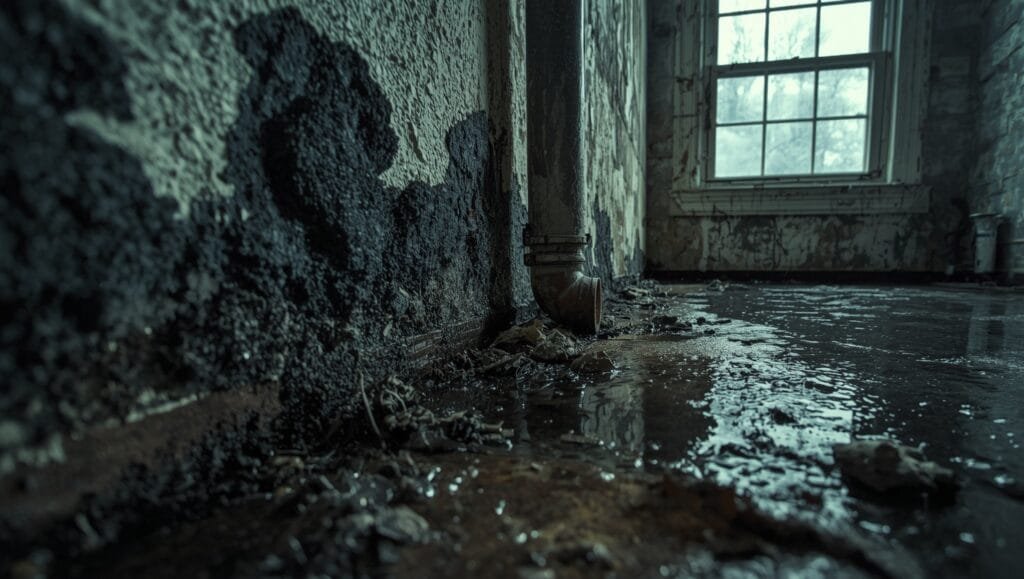
Water leaks from pipes, roof damage, or flooding seep into wall cavities and crawl spaces.
The drywall stays wet, and mold starts feeding on the cellulose.
From the outside, the wall looks fine.
Inside, it’s a mold farm.
Above Drop Ceilings
Commercial buildings love drop ceilings—they hide wiring, pipes, and ductwork.
They also hide mold.
Roof leaks, condensation from HVAC, or plumbing issues drip directly onto the area above the tiles.
The tiles absorb moisture, and boom—mold starts growing in a space nobody ever looks at.
In Basement and Crawl Spaces
Basements are naturally damp.
Add a water intrusion event (heavy rain, sump pump failure, foundation crack) and you’ve got the perfect mold environment.
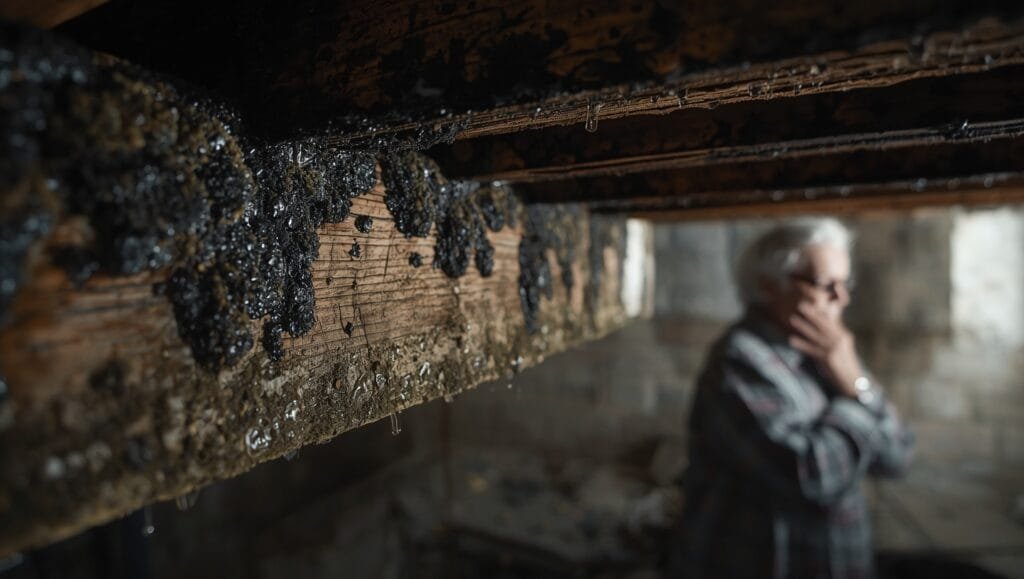
Most business owners don’t spend much time in their basements, so mold can spread for weeks before anyone notices.
Around Plumbing and Fixtures
Slow leaks under sinks, around toilets, or from broken pipes create constant moisture.
Mold grows around these areas silently.
By the time you spot water damage, mold has already colonized.
Bottom line: Mold hides where moisture hides—and moisture is everywhere in commercial buildings.
The Real Cost of Ignoring Commercial Mold Damage
Let’s talk numbers, because this is where the pain gets real.
Ignoring commercial mold damage restoration isn’t just a health issue—it’s a financial disaster waiting to happen.
Immediate Costs
The longer mold grows, the bigger the remediation project becomes.
A small mold issue caught early might cost $2,000 to $5,000 to fix.
The same issue ignored for three months?
That’s now a $15,000 to $30,000 project because the mold has spread to multiple areas, damaged structural materials, and contaminated the HVAC system.
Structural Damage
Mold eats through drywall, wood framing, and insulation.
Once it starts breaking down building materials, you’re not just dealing with mold removal—you’re dealing with replacement and reconstruction.
That’s expensive.
Business Interruption
During commercial mold damage restoration, you might need to shut down sections of your building or even the entire operation.
A retail store losing a week of sales?
An office losing productivity?
A restaurant losing food service revenue?
That adds up fast.
Employee Liability and Health Claims
If employees get sick from mold exposure and you knew about it but didn’t address it, you’re looking at workers’ compensation claims, lawsuits, and reputation damage.
Some states have specific mold liability laws that can hit you hard.
Insurance and Regulatory Fines
Health inspections might result in violations.
Insurance companies might deny claims if they determine you were negligent.
OSHA can fine businesses for unsafe working conditions.
These penalties stack up.
Bottom line: Waiting to address mold costs way more than fixing it fast.
What Professional Commercial Mold Damage Restoration Actually Involves
Here’s what separates a real restoration company from someone who just sprays bleach and hopes for the best:
Assessment and Inspection
The first step is figuring out the actual scope of the problem.
This means checking visible areas, but also using moisture meters, thermal imaging, and air quality testing to find hidden mold and moisture.
A thorough inspection takes time—it’s not a quick walk-through.
Containment
Before any removal happens, the affected area gets sealed off.
Plastic sheeting, negative air pressure systems, and HEPA filters prevent mold spores from spreading to clean areas of your building while work is happening.
This is critical in commercial settings where you have multiple tenants or departments.
Water Mitigation
If mold is present, water damage is usually the cause.
That water needs to be removed and the affected materials need to dry completely.
This might involve industrial-grade dehumidifiers, air movers, and moisture monitoring over several days.
Mold Removal and Material Disposal
Contaminated materials get carefully removed and disposed of according to EPA guidelines.
This isn’t a spray-and-pray situation—it’s a systematic removal process.
Sometimes that means replacing drywall, flooring, or insulation.
HVAC System Cleaning
If your air distribution system was exposed to mold, it needs professional cleaning.
Check out air duct cleaning services to understand how this process works.
Final Testing and Clearance
Once remediation is complete, the space gets tested to confirm mold levels are back to normal.
Some jurisdictions require clearance testing before the building can be reoccupied.
This protects you legally.
Bottom line: Real commercial mold damage restoration is thorough, documented, and done by trained professionals.
Why You Need Professional Help (Not Your Maintenance Team)
Here’s a conversation we hear all the time:
“Our maintenance guy says he can handle it. We’ll just clean it with some bleach and a fan.”
Please don’t do this.
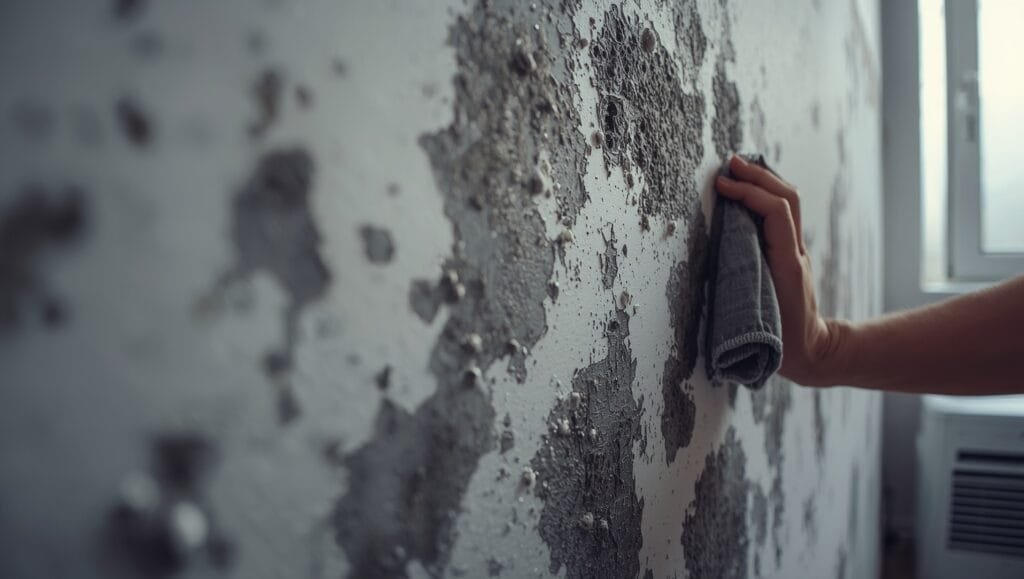
Bleach kills mold on the surface, but it doesn’t kill mold spores in the air or mold that’s embedded in porous materials.
Plus, bleach doesn’t address the root cause—moisture.
If you don’t fix the moisture problem, the mold comes right back.
Professional commercial mold damage restoration companies have:
Proper Equipment
Industrial-grade dehumidifiers, HEPA air scrubbers, moisture meters, thermal imaging cameras, and containment systems.
Your maintenance guy doesn’t have this stuff.
Training and Certification
Certified mold remediation specialists understand EPA guidelines, building codes, and industry best practices.
They know how to document the process for insurance and regulatory purposes.
Legal Protection
When a professional company handles mold remediation, you’ve got documentation, guarantees, and insurance backing the work.
If something goes wrong, you’re protected.
If your maintenance team handles it and someone gets sick, you’re exposed.
Speed and Expertise
A professional team knows exactly what needs to happen and in what order.
They work fast because they do this every day.
Your maintenance team is juggling ten other projects while trying to figure out mold.
Bottom line: Professional restoration beats DIY every single time in commercial settings.
The Timeline: How Long Does Commercial Mold Damage Restoration Take?
Business owners always want to know: how long until we can get back to normal?
The honest answer: it depends.
Small, Localized Issue (One Room, Limited Spread)
3 to 7 days.
This assumes the mold hasn’t penetrated deep into walls or the HVAC system, and the moisture source is already fixed.
Moderate Issue (Multiple Rooms, Some Wall Damage)
1 to 3 weeks.
This involves more containment, material removal, and drying time.
You might be able to operate in unaffected areas while work happens.
Severe Issue (Widespread Contamination, Structural Damage, HVAC Involved)
3 weeks to 2 months.
This is a major project that might require temporary relocation of staff or operations.
The drying and clearance testing phases take significant time.
The timeline also depends on how quickly your building dries out and how cooperative the weather is (humid conditions slow the drying process).
Bottom line: Fast response prevents long timelines—delays make everything worse.
Getting Started: What to Do Right Now If You Suspect Commercial Mold
You’ve spotted something suspicious.
Maybe it’s a musty smell, visible discoloration, or you know there’s been water damage.
Here’s what to do immediately:
Document Everything
Take photos and videos of any visible mold, water damage, or suspicious areas.
Note when you first noticed it and what might have caused it (leak, flooding, condensation, etc.).
This documentation matters for insurance claims and professional assessment.
Stop the Water Source
If there’s an active leak, get it fixed now.
If it’s from flooding, make sure drainage is working properly.
Mold can’t grow without moisture—eliminate the source and you stop the spread.
Increase Air Circulation
Open windows, turn on fans, and get air moving through the affected area.
This won’t eliminate mold, but it helps slow growth while you arrange professional help.
Don’t Touch It
Disturbing mold releases spores into the air, making the problem worse and exposing people to contamination.
Leave it alone until professionals can handle it safely.
Call a Professional Immediately
Don’t wait, don’t experiment with DIY solutions, don’t hope it goes away.
The faster you get professional eyes on this, the faster and cheaper the fix will be.
Walt and his team at JetDry offer 24/7 emergency response for commercial mold damage restoration across Rochester, NY.
They can dispatch a team same-day to assess your situation and create a remediation plan.
Bottom line: Speed is everything—call professionals before the problem explodes.

Insurance Won’t Cover It. Your Accountant Will Hate You. The Hidden Costs of Slow Commercial Mold Damage Restoration
A property manager in Rochester called JetDry on a Thursday afternoon.
They’d noticed a slight smell in the break room three weeks prior.
Didn’t seem urgent, so they scheduled a contractor for “sometime next month.”
By the time the inspection happened, mold had colonized the entire HVAC system, contaminated the ceiling plenum, and started spreading to three adjacent office suites.
The bill went from an estimated $4,000 to $67,000.
Insurance denied the claim because the delay was considered negligence.
The property manager got fired.
That’s what happens when commercial mold damage restoration gets pushed to the back burner.
It’s not just about the mold itself anymore—it’s about liability, insurance coverage, employee lawsuits, and regulatory violations that can sink a business.
Let’s talk about the real financial fallout nobody warns you about.
Why Insurance Companies Are Watching Your Mold Response Like a Hawk
Here’s something most business owners don’t realize until it’s too late: your insurance company is judging your mold response timeline.
Seriously.
If you know about mold and don’t act fast, insurers can argue you were negligent—which means they can deny your claim entirely.
It’s not fair, but it’s legal.
Insurance policies have language about “prompt action” and “reasonable mitigation efforts.”
What does “prompt” mean?
Most adjusters interpret it as within 24 to 48 hours of discovery.
If you wait a week, you’re already in risky territory.
If you wait a month, you’ve basically handed them a reason to deny your claim.
One retail owner in upstate New York discovered mold in their stockroom on a Friday.
They called contractors on Monday, got a quote by Wednesday, and approved the work for the following week.
Insurance denied the claim because there was a five-day gap between discovery and professional assessment.
The company paid $18,000 out of pocket.
The kicker?
If they’d called JetDry that same Friday for emergency assessment—even just a consultation—they’d have documented proof of immediate action.
That documentation would’ve protected their claim.
Bottom line: Insurance companies reward speed—delays give them an exit door.
The Liability Trap: When Employees Get Sick and Point the Finger at You
You’ve got mold growing in the building.
An employee develops respiratory issues—chronic cough, shortness of breath, asthma-like symptoms.
They go to a doctor.
The doctor documents the symptoms and notes potential mold exposure.
Now you’re facing a workers’ compensation claim.
If the employee can prove you knew about the mold and didn’t act, you’re looking at:
Medical bills (often $5,000 to $15,000+ for respiratory issues).
Lost wages during treatment or recovery.
Potential permanent disability settlement.
Legal fees defending yourself.
Increased workers’ comp insurance premiums.
In some cases, punitive damages if a court determines you were reckless.
A manufacturing facility in Rochester discovered black mold in their warehouse in March.
They cleaned it with a mop and bleach—no professional remediation.
By July, three employees filed workers’ compensation claims for mold-related illness.
The company’s insurance premiums jumped 40%, and they settled the claims for $85,000.
The entire situation could’ve been avoided with a $6,000 professional restoration in March.
And here’s the thing—OSHA can step in too.
If a worker reports mold exposure to OSHA and the agency investigates, they can fine you for creating an unsafe workplace.
Fines range from $10,000 to $156,000 per violation, depending on severity.
Bottom line: Ignoring mold turns employees into plaintiffs—fast action prevents lawsuits.
The Health Department Is Coming. Are You Ready?
If you run a food service operation, healthcare facility, or any business with regular health inspections, mold isn’t just a problem—it’s a shutdown waiting to happen.
Health departments have zero tolerance for active mold contamination.
An inspector spots mold in a restaurant kitchen?
That’s an immediate violation.
The facility gets cited, and the owner has to show proof of professional remediation before the business can reopen.
We already know what happened to the Rochester restaurant owner at the beginning of this series—they lost an entire week of revenue.
But there’s more damage than that.
Health violations go on your public record.
They show up on inspection databases that customers can access.
One bad inspection can tank your online reputation and drive customers to competitors.
A daycare center in the Rochester area discovered mold in their bathroom and HVAC system.
They reported it to the health department (legally required in most states).
The health department issued a violation, and the facility had to close for two weeks during remediation.
Parents pulled their kids out.
Enrollment dropped 35% even after the mold was gone.
The financial hit: over $40,000 in lost tuition revenue, plus the remediation cost.
The reputational hit lasted much longer.
Now, here’s the thing—if that daycare had called for professional assessment the moment they noticed mold, they could’ve arranged remediation outside of operating hours or in phases that minimized disruption.
They could’ve documented everything properly and possibly avoided the shutdown entirely.
Bottom line: Health violations are public, permanent, and expensive—prevention beats citations every time.
Structural Damage Compounds Your Costs Exponentially
Mold doesn’t just sit on surfaces.
It eats through building materials.
When you delay commercial mold damage restoration, you’re not just dealing with mold removal—you’re dealing with reconstruction.
Let’s break down what happens over time:
Week 1-2 of Mold Growth
Mold colonizes on surfaces, mostly cosmetic damage.
Remediation cost: $2,000–$5,000.
Week 3-4
Mold penetrates into drywall and insulation.
You’re starting to need material replacement.
Remediation cost: $8,000–$15,000.
Month 2-3
Mold has compromised structural integrity of walls and framing.
Wood rot is setting in.
You need drywall replacement, possibly wood framing repairs, and insulation replacement.
Remediation cost: $25,000–$50,000.
Month 4+
Structural damage is severe.
You might need to replace entire wall sections or even portions of the roof.
Remediation cost: $75,000+.
A small office building in upstate New York had a roof leak that went unnoticed for four months.
Mold spread through the attic and down into the walls.
By the time they called for help, the remediation cost $120,000.
If they’d called within the first week, the cost would’ve been $8,000.
That’s a $112,000 difference—all because of a delay.
And the building was still under construction issues for another two months.
Bottom line: Every week you wait, the remediation cost multiplies—early action saves thousands.
The Domino Effect: Lost Productivity, Lost Customers, Lost Credibility
When commercial mold damage restoration finally happens, your business doesn’t just stop—it often gets worse before it gets better.
Here’s why:
During remediation, you might need to shut down sections of your building or relocate staff.
If you’re a retail operation, you’re losing sales during closure.
If you’re an office, employees are working remotely or from temporary locations—productivity tanks.
If you’re a restaurant or food service, you’re losing revenue and disappointing customers who show up to find you closed.
But the real damage is deeper than that.
Customers talk.
If word gets out that your business had a mold problem, people assume you’re dirty or poorly managed.
That perception sticks, even after the mold is gone.
A boutique fitness studio in Rochester had to close for three weeks due to mold in their HVAC system.
They lost $25,000 in membership fees during that period.
After reopening, they lost another 40% of their membership base because people didn’t want to work out in a building that “had a mold problem.”
It took them eight months to rebuild their client base.
The total financial impact: $85,000+ in lost revenue, plus remediation costs.
If they’d caught and fixed the mold within the first 48 hours, they could’ve handled it silently without any customer knowledge.
Instead, they spent months recovering their reputation.
Bottom line: Speed keeps mold problems private—delays turn them into public relations disasters.
Tenant Disputes and Lease Violations: The Legal Minefield
If you own or manage commercial real estate with multiple tenants, mold becomes a lease enforcement nightmare.
Most commercial leases have clauses requiring the landlord to maintain the property in safe, habitable condition.
Mold violates that clause.
If a tenant discovers mold and you don’t address it quickly, they can:
Withhold rent (legal in many states).
Break the lease without penalty.
Sue for damages and health-related expenses.
File complaints with local health or building departments.
A multi-tenant office building in Rochester had mold in the shared HVAC system.
The landlord knew about it but delayed remediation to save money.
Three tenants withheld rent and demanded lease termination.
One tenant sued for $30,000 in damages (claiming employee illness and lost productivity).
The landlord ended up spending $60,000 on legal fees, settlements, and lost rent—plus the $18,000 remediation cost they were trying to avoid.
They could’ve fixed it for $6,000 in the first place.
And here’s another thing: if you’re the tenant in a space with mold and the landlord won’t fix it, you have rights.
But you need to document everything and act fast.
Call a professional like JetDry for assessment, get it in writing, and notify your landlord immediately with documentation.
That protects your position if you need to pursue legal action.
Bottom line: Mold in commercial real estate creates tenant disputes—speed resolves them before they escalate.
The Ripple Effect: Vendor Relationships and Business Partnerships
You might not think about this, but mold can damage your business relationships.
If you operate a warehouse or manufacturing facility, vendors and suppliers visit your space.
They see mold, they talk.
Word spreads that your facility is compromised.
Some vendors might refuse to work with you, thinking your operation is poorly managed.
Clients considering partnerships might walk away.
A logistics company in Rochester had mold in their warehouse.
A major client visited to inspect inventory and saw visible mold in the storage area.
The client immediately moved their inventory to a competitor’s facility.
That one client represented 15% of the company’s revenue.
They lost $200,000+ in annual business because of a mold problem that could’ve been fixed for $12,000.
Bottom line: Mold damages vendor trust—professional remediation protects your business relationships.
Documentation Matters: Building Your Defense Now
Here’s something Walt and his team at JetDry stress to every commercial client: documentation is your insurance policy.
When you call a professional immediately—even if it’s just for assessment—you create a paper trail.
That documentation protects you in multiple ways:
Insurance Claims
You’ve got proof you acted promptly, which satisfies your insurance policy requirements.
Claims adjusters can see you took the problem seriously.
Legal Defense
If an employee sues or a tenant disputes, you’ve got evidence you responded professionally.
You can show you called certified professionals, followed industry standards, and completed remediation properly.
Regulatory Compliance
Health departments, OSHA, and building inspectors want to see documentation.
Professional remediation companies provide detailed reports, testing results, and clearance certificates.
That documentation proves compliance.
Future Liability
If someone gets sick years later and tries to claim it’s related to past mold exposure, you’ve got proof you remediated it properly.
A professional assessment and remediation report is your best defense.
When you hire JetDry for commercial mold damage restoration, you get:
Detailed inspection reports with photos and moisture readings.
Remediation plans with scope and timeline.
Daily progress documentation.
Final clearance testing and certification.
Insurance-backed guarantees on the work.
That’s the kind of documentation that holds up in court, satisfies insurance companies, and protects you from regulatory violations.
Bottom line: Professional documentation is your legal shield—DIY has zero protection.
The Math: What Fast Action Actually Costs vs. What Delay Costs
Let’s do some real math here.
These aren’t made-up numbers—they’re based on cases JetDry has handled in Rochester and surrounding areas.
Scenario 1: Fast Response (Within 48 Hours)
Professional assessment: $500.
Small-to-moderate remediation: $4,000–$8,000.
HVAC inspection and cleaning (if needed): $1,500–$2,500.
Final clearance testing: $800–$1,200.
Total: $7,000–$12,000.
Business downtime: 2–5 days, minimal disruption.
Lost revenue: $0–$5,000 (depending on operation size).
Total financial impact: $7,000–$17,000.
Scenario 2: Delayed Response (2-4 Weeks)
Professional assessment: $500.
Moderate-to-severe remediation (with material replacement): $15,000–$30,000.
HVAC system cleaning and ductwork replacement: $3,500–$6,000.
Structural repairs (drywall, framing, insulation): $8,000–$20,000.
Final clearance testing: $800–$1,200.
Potential health department violations: $5,000–$15,000 (fines, corrective actions).
Total: $33,000–$73,000.
Business downtime: 3–4 weeks, major disruption.
Lost revenue: $25,000–$60,000 (depending on operation size).
Potential employee claims or legal fees: $10,000–$50,000.
Reputation damage and lost customers: $5,000–$100,000+ (long-term).
Total financial impact: $73,000–$283,000.
The difference between fast response and delayed response isn’t just thousands—it’s tens of thousands or more.
And that’s being conservative.
Bottom line: Fast remediation costs $7–17K; delays cost $73–283K—the math is brutal.
FAQ: Commercial Mold Damage Restoration Questions Answered
What should I do the moment I suspect mold in my commercial building?
Call a professional immediately—even for just an assessment. Document everything (photos, dates, observations), stop any active water sources, and increase air circulation. Don’t let employees or customers in affected areas, and don’t attempt DIY remediation.
Will my commercial insurance cover mold remediation?
It depends on your policy and how quickly you act. Most commercial policies require prompt action (within 24–48 hours of discovery) to validate a claim. If you delay, insurers can deny coverage by arguing negligence. Always call a professional immediately and get documentation of your response.
How long can a business stay open during mold remediation?
It varies. Small, localized issues might allow you to operate in unaffected areas. Severe contamination often requires temporary closure or relocation. A professional assessment will tell you what’s possible—and fast action usually means you can stay partially operational.
Can I use my maintenance team to handle mold instead of calling professionals?
No. Maintenance staff aren’t trained in mold remediation, don’t have proper equipment, and can’t provide the documentation you need for insurance or regulatory compliance. Professional remediation protects you legally and ensures the mold doesn’t come back.
What’s the difference between mold inspection and mold remediation?
Inspection identifies the problem and scope. Remediation fixes it. You need both—inspection tells you what to fix, and remediation removes it properly. Professional mold remediation services include both steps.
How much does commercial mold remediation cost?
Small issues: $2,000–$8,000. Moderate issues: $8,000–$30,000. Severe issues: $30,000+. The cost depends on the extent of contamination, structural damage, and HVAC involvement. Fast response keeps costs low; delays multiply them.
Will my business reputation recover after a mold problem?
Yes, if you handle it professionally and quietly. Fast remediation means fewer people know about it. Long delays and public health violations damage reputation for months or years. Speed is your best PR strategy.
The Bottom Line: Speed Isn’t Optional, It’s Essential
Commercial mold damage restoration isn’t a “someday” project.
It’s a right-now project.
Every hour you wait costs you money, legal exposure, and business credibility.
The difference between a $10,000 fix and a $100,000+ disaster is often just 48 hours.
Walt and his team at JetDry have been protecting Rochester businesses for over 20 years.
They offer 24/7 emergency response for commercial mold—same-day assessment, documented remediation, and clearance testing.
That documentation is your legal protection.
That speed is your financial protection.
If you suspect mold in your commercial space—anywhere in Rochester or surrounding areas—don’t wait.
Contact JetDry now for immediate assessment.
The cost of that call is nothing compared to the cost of delay.

Your Employees Are Getting Sick and You Don’t Even Know It Yet. The Silent Health Crisis Hiding in Your Commercial Mold.
A warehouse manager in Rochester noticed his team was calling in sick more often.
Coughing, headaches, fatigue—nothing serious enough to report, but enough to disrupt productivity.
Three months later, one employee went to a pulmonologist and got diagnosed with mold-induced asthma.
That’s when the manager realized the “musty smell” in the back corner wasn’t just a smell.
It was a health time bomb.
Commercial mold damage restoration isn’t just about fixing the building—it’s about protecting the people inside it.
And the truth is, most business owners don’t connect the dots until it’s too late.
Why Mold Symptoms Show Up Slowly (And Why That’s Dangerous)
Mold doesn’t announce itself.
People don’t wake up one day with severe symptoms.
Instead, it creeps in—a scratchy throat here, a persistent cough there, some fatigue that employees blame on poor sleep.
The problem is that mold exposure builds over time.
Your lungs are accumulating spores day after day, week after week.
By the time someone feels bad enough to see a doctor, they’ve been breathing contaminated air for months.
And here’s the kicker: not everyone reacts the same way.
One employee might develop respiratory issues while another just gets chronic headaches.
A third person might have no symptoms at all but is still inhaling spores.
That variation in symptoms makes it nearly impossible for business owners to spot a mold problem early.
You’re waiting for someone to collapse, not realizing that the quiet discomfort your team is experiencing is actually a red flag.
An office building in upstate New York had mold growing in their HVAC system for six months.
During that time, absenteeism increased 22%, and three employees filed workers’ comp claims.
The owner didn’t connect the dots until an HVAC technician doing routine maintenance spotted the contamination.
The health damage was already done, but at least the source was finally removed.
Bottom line: Mold symptoms hide in plain sight—by the time you notice, exposure is already serious.
The Vulnerable Populations in Your Building (And Your Legal Exposure)
Some people are way more susceptible to mold than others.
If you’ve got employees with asthma, allergies, or compromised immune systems, they’re at higher risk.
Same goes for older workers and anyone taking medications that weaken their immune response.
Children are also more vulnerable—which matters if you run a daycare, school, or facility where kids spend time.
As a business owner, you have a legal duty to provide a safe workplace.
That includes protecting vulnerable populations from mold exposure.
If you know mold exists and you don’t act, and then a vulnerable employee gets sick, you’re looking at serious liability.
The employee can argue you knowingly exposed them to a hazard.
Damages can include medical costs, lost wages, pain and suffering, and sometimes punitive damages if a court thinks you were reckless.
A fitness facility in Rochester hired a new instructor with mild asthma.
Within two weeks, she developed severe respiratory issues and had to quit.
She later discovered that the gym had mold in its ventilation system that management knew about but hadn’t addressed.
She sued and won a settlement covering her medical bills, lost wages, and additional damages.
The gym could’ve prevented that entire situation with a $5,000 commercial mold damage restoration.
Bottom line: Vulnerable employees mean higher liability—protecting them protects your business.
Presenteeism: The Productivity Killer Nobody Talks About
You know what absenteeism is—employees calling in sick.
But there’s something worse called presenteeism: employees showing up but not performing.
They’re there, but their brain’s foggy, they’re moving slow, they’re making mistakes.
Mold exposure causes this.
Chronic low-level exposure to mold spores triggers inflammation in the respiratory system and brain fog that people don’t even realize is happening.
An employee might not feel sick enough to stay home, but they’re running at 60% capacity.
Multiply that across your whole team and you’re looking at serious productivity loss.
One study found that indoor air quality issues (including mold) reduce cognitive function by 15%.
That means slower decision-making, more errors, and lower output.
For a team of 20 people, that’s like losing three full-time employees’ worth of productivity.
An accounting firm in Rochester noticed their error rate on client work had jumped 18% over three months.
They brought in a consultant to figure out what was wrong with their processes.
Turns out, it wasn’t the processes—it was the air.
Mold in their basement was being pulled up through the HVAC system into the main office.
Once they did professional commercial mold damage restoration, error rates dropped back to normal within two weeks.
They didn’t lose any employees, but they recovered thousands in lost productivity.
Bottom line: Mold reduces brain function—fix it and watch your team’s performance jump.
The Respiratory Red Flags Your Team Is Showing (But You’re Missing)
If you’re paying attention, mold exposure leaves clues.
Here’s what to listen for when talking to your team:
Persistent cough that won’t go away even after weeks of “being sick.”
Shortness of breath during normal activity—climbing stairs, walking to meetings, nothing strenuous.
Wheezing or chest tightness that employees describe as “feeling tight” when they breathe.
Frequent sinus infections or congestion that comes and goes.
Headaches that are worse at the end of the workday and better on weekends.
Skin irritation or itching that employees can’t explain.
Eye irritation—red, watery eyes that get better when they leave the building.
The last one is especially telling because it’s so specific.
If multiple employees mention their eyes feel better when they’re not at work, that’s a major red flag.
It means the air quality in your building is the problem.
A dental office in Rochester had three employees mention that their eyes felt irritated during work.
The dentist thought it was the dust from drilling or the disinfectants they used.
Turns out, there was mold in the sterilization room that was spreading through the office’s air system.
Once they fixed it with professional commercial mold damage restoration, the eye irritation disappeared.
Bottom line: Respiratory symptoms cluster together—notice the pattern and act fast.
Mold and Mental Health: The Connection Nobody Expects
Here’s something that surprises people: mold exposure affects mood and mental health.
It’s not just physical—it’s psychological too.
When you’re constantly breathing in mold spores, your body’s inflammatory response stays activated.
That chronic inflammation affects neurotransmitters and can trigger or worsen anxiety and depression.
Employees might report feeling more stressed, anxious, or just generally “off” without understanding why.
They might blame it on work pressure or personal stuff, not realizing the building itself is affecting their mental state.
Some research suggests that people exposed to mold indoors report higher rates of mood disorders and cognitive issues.
It’s not just correlation either—there’s a real biological mechanism at work.
An office manager in Rochester noticed her team seemed more irritable and anxious than usual.
People were snapping at each other, stress levels were high, and overall morale was tanking.
She brought in a mental health consultant thinking there was a workplace culture issue.
While they were doing their assessment, an HVAC technician discovered mold in the building’s ductwork.
Once they did the commercial mold damage restoration, the mood in the office shifted noticeably within a week.
People were calmer, more collaborative, and stress levels dropped.
It wasn’t a culture problem—it was a mold problem.
Bottom line: Mold affects mood—if your team’s attitude shifts, check the air quality first.
Creating a Mold-Aware Culture (Before Problems Happen)
Smart business owners train their teams to spot mold early.
Not in a paranoid way, but in a practical “let’s protect ourselves” way.
Your employees spend eight hours a day in your building—they notice things before you do.
If they know what to look for, they can alert you to problems before they become disasters.
Train your team on the basics: musty smells, visible discoloration, water stains, soft spots on ceilings or walls, condensation on windows or pipes.
Tell them that if they notice any of these things, they should report it to management immediately.
Make it easy—create a simple form or a direct line where they can report concerns without feeling like they’re causing trouble.
The best part about creating this culture is that it protects you legally too.
If an employee later claims they didn’t know about a mold problem, you’ve got documentation showing you created a reporting system.
You can show that you took it seriously.
A manufacturing facility in Rochester implemented a monthly “building walkthrough” where employees from different departments checked their areas for potential issues.
They caught a mold problem in the corner of the warehouse that had been growing silently for weeks.
Because they caught it early, the commercial mold damage restoration was straightforward and cheap.
Plus, employees felt valued because their observations actually mattered.
Bottom line: Train your team to spot mold—early reporting saves health and money.
The Seasonal Mold Spike (And Why Winter and Spring Are Danger Zones)
Mold doesn’t grow at the same rate year-round.
It accelerates during certain seasons, and if you’re not paying attention, you’ll miss the window to catch it early.
Winter brings indoor heating, which dries the air—but it also means closed windows and poor ventilation.
If there’s any moisture intrusion (a roof leak, a pipe crack), that moisture gets trapped inside.
Spring brings rain and humidity, which means more water getting into walls and basements.
Summer’s hot and humid, which speeds up mold growth if there’s any moisture present.
Fall brings temperature swings that create condensation on pipes and windows.
The real danger zone is late winter into spring—that’s when hidden mold that started growing in fall or early winter suddenly explodes.
You might not have noticed it growing quietly, but suddenly the problem is massive.
That’s why professional commercial mold damage restoration companies get slammed in March and April.
Business owners finally notice the problem that’s been brewing for months.
If you want to get ahead of this, do a professional inspection in late winter—before the spring rush.
A commercial mold remediation inspection can identify problems before they blow up.
Bottom line: Spring triggers mold growth—inspect in winter to catch problems early.
Post-Remediation Health Recovery: How Long Until Your Team Feels Better?
Once you’ve done professional commercial mold damage restoration, people don’t instantly feel better.
That’s not how the body works.
If someone’s been breathing mold spores for months, their respiratory system is inflamed.
Their immune system is activated.
Even after the mold is gone, it takes time for that inflammation to calm down.
Most people start feeling noticeably better within one to two weeks after remediation is complete.
The persistent cough starts to ease, brain fog clears, energy levels improve.
But full recovery—especially for people with mold-induced respiratory issues—can take four to eight weeks.
Some people take even longer, depending on how severe their exposure was.
Here’s why this matters: don’t expect your team’s productivity to bounce back immediately after you fix the mold.
Give them time to recover.
You might also want to be more flexible with sick days or remote work during the recovery period.
Your team’s been dealing with a health issue they didn’t even know they had—be patient as they bounce back.
An insurance office in Rochester did their commercial mold damage restoration in February.
By mid-March, employees were reporting that they felt better—less coughing, clearer thinking, better mood.
By April, absenteeism had dropped 35% compared to the previous year.
That health recovery translated directly to business recovery.
Bottom line: Health recovery takes weeks—be patient and watch productivity rebound.
FAQ: Commercial Mold Health Questions Answered
Can mold exposure cause permanent lung damage?
Prolonged exposure to certain mold types can cause chronic respiratory conditions, but most damage is reversible if the mold is removed and the person gets appropriate medical care.
Should I have my employees medically evaluated after mold exposure?
If employees have symptoms or you’ve had significant mold contamination, offering voluntary medical evaluations protects them and documents your response—which is valuable if legal issues arise later.
Do I need to tell my employees about mold in the building?
Yes. Transparency builds trust and also protects you legally—it shows you’re not hiding the problem. Explain what you found, what you’re doing about it, and when remediation will be complete.
Can mold in commercial buildings cause asthma in people who didn’t have it before?
Yes. Mold exposure can trigger the development of asthma or asthma-like symptoms in people without prior history, especially with prolonged exposure.
What’s the link between mold and allergies?
Mold spores are allergenic—they trigger immune responses in sensitive individuals, causing sneezing, congestion, itchy eyes, and skin reactions.
Protect Your Team Now, Save Your Business Later
The health crisis hiding in your commercial building isn’t just a mold problem.
It’s a people problem.
Your employees’ health is directly connected to your business’s success.
Sick, cognitively impaired, anxious employees can’t perform at their best.
They call in more, make more mistakes, and eventually leave for healthier work environments.
The cost of that turnover—recruiting, training, lost productivity—dwarfs the cost of commercial mold damage restoration.
Walt and his team at JetDry have been protecting Rochester businesses and their employees for over 20 years.
They understand that commercial mold restoration isn’t just about the building—it’s about the people inside it.
If you suspect mold in your commercial space, don’t wait for your team to start showing symptoms.
Contact JetDry now for a professional assessment and protect your team’s health today.